HbA1c vs blood sugar — I stared at both numbers on my lab results for twenty minutes without understanding what either of them actually meant. My doctor had circled the HbA1c in red. My fasting glucose looked fine to me. I left that appointment more confused than when I arrived, and it took me several months of reading, testing, and asking questions I probably should have asked in the room to finally understand the difference between the two.
If you have ever looked at a blood test and wondered why there are two separate measurements for something called blood sugar — you are not alone. Most people do not get a clear explanation. They get a number, maybe a reference range, and a general instruction to eat better. That is not enough information to actually do anything useful with.
Here is what the HbA1c vs blood sugar distinction actually means — and why understanding it changed how I tracked my own health completely.
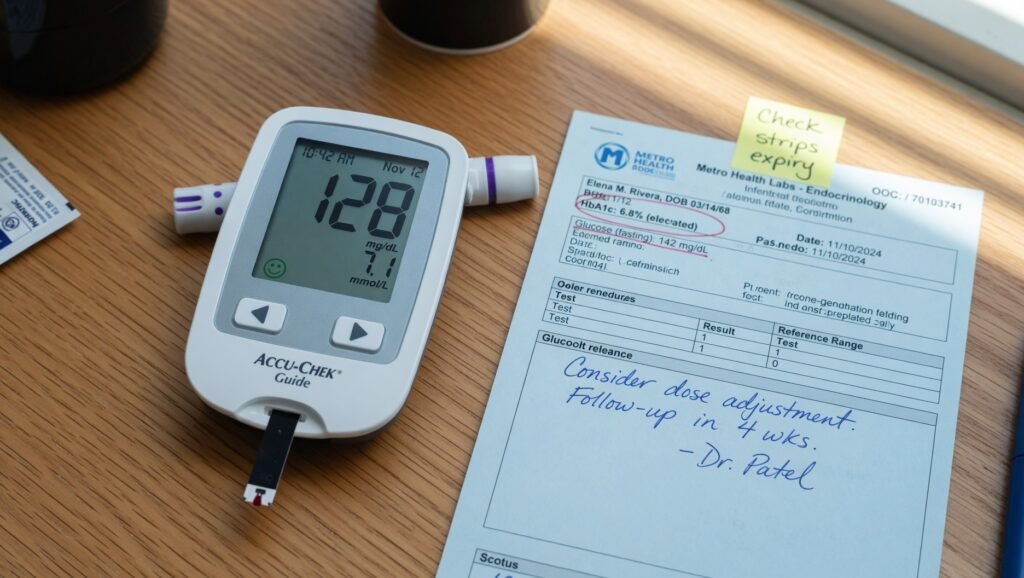
What Blood Sugar Actually Measures
A standard blood sugar test — fasting glucose — measures the amount of glucose in your blood at a single point in time. You fast overnight, blood is drawn in the morning, and the result tells you what your blood sugar was at that exact moment. Nothing more.
Normal fasting glucose is generally below 100 mg/dL. Between 100 and 125 is considered prediabetic range. Above 126 on two separate tests is the threshold for a diabetes diagnosis. These are the numbers most people are familiar with, and they are useful — but they tell you nothing about what your blood sugar was doing the day before, or the week before, or at 2pm when you usually crash after lunch.
And honestly, that is the limitation. A single snapshot. I had a fasting glucose of 94 for two years. Completely normal. Meanwhile my HbA1c was telling a different story — one I was not paying attention to because I was so focused on that single fasting number. Blood sugar alone does not give you the full picture. It gives you one frame from a very long film.
What HbA1c Actually Measures — And Why It Is Different
HbA1c — glycated hemoglobin — measures the percentage of hemoglobin in your red blood cells that has glucose attached to it. Red blood cells live for roughly three months. During that time, glucose in the bloodstream binds to hemoglobin in proportion to how much glucose has been present. The higher your blood sugar has been over those three months, the more glucose sticks to the hemoglobin, and the higher the HbA1c.
This is why the HbA1c vs blood sugar comparison matters so much — they are measuring completely different things. Fasting blood sugar is a point-in-time measurement. HbA1c is a three-month average. One tells you where you are right now. The other tells you where you have been living.
Normal HbA1c is below 5.7 percent. Between 5.7 and 6.4 is prediabetic range. Above 6.5 on two separate tests is the clinical threshold for diabetes. Each 1 percent change in HbA1c corresponds roughly to a 30 mg/dL change in average blood sugar. So an HbA1c of 6.0 reflects an average blood sugar of around 126 mg/dL over the past three months — even if your fasting glucose looks fine on any given morning.
That was me. Fasting glucose fine. HbA1c creeping up. The fasting test was catching me at my best. The HbA1c was catching me at my average — and my average was not what I thought it was.

Why Fasting Glucose Can Look Fine While HbA1c Is Elevated
This is the part that confuses most people. How can fasting blood sugar be normal while HbA1c is elevated? The answer is post-meal spikes. Fasting blood sugar only captures what happens after an overnight fast, when the body has had many hours to clear glucose from the bloodstream. But what happens after you eat — the post-meal spike — is not captured by fasting glucose at all.
Someone can have a normal fasting number and still be experiencing significant blood sugar spikes after every meal, day after day, for months. Those spikes do not show up in fasting glucose. They do show up in HbA1c. Post-meal spikes are where a lot of the damage from blood sugar dysregulation actually happens — chronic elevation after meals is associated with cardiovascular risk, oxidative stress, and the gradual progression toward insulin resistance.
Understanding the HbA1c vs blood sugar distinction helped me see that I needed to pay attention to what happened after I ate, not just what my numbers looked like on an empty stomach in the morning. This connects directly to the warning signs of high blood sugar that often appear between meals — the afternoon fatigue, the difficulty concentrating, the cravings that feel urgent. Those are post-meal spikes playing out in real time.
Which One Should You Track — And How Often
Both. But for different purposes and at different frequencies. HbA1c should be tested every three to six months if you are managing blood sugar issues, or at least once a year if you are in the normal range but want to monitor trends. It gives you the long-term picture and is the gold standard for diagnosing and tracking diabetes and prediabetes.
But because it reflects a three-month average, it does not respond quickly to recent changes. If you change your diet dramatically this week, your HbA1c will not reflect that improvement for another two to three months. Fasting blood sugar — or post-meal blood sugar checks if you have a monitor — gives you more immediate feedback. If you want to know how a specific food or meal affected your blood sugar, a monitor checked ninety minutes after eating tells you something HbA1c cannot.
I borrowed a continuous glucose monitor for two weeks specifically to understand my post-meal patterns. What I found was that my fasting blood sugar was genuinely fine. My post-lunch spikes were not. That two-week window told me more about my actual HbA1c vs blood sugar situation than any single lab result had. Combining both measurements gives the most complete picture of what is actually happening in your body.
Fasting blood sugar tells you where you are right now. HbA1c tells you where you have been living for three months. You need both.
Learn More About Sugar Defender 24 →
Limitations of HbA1c That Most People Are Not Told
The HbA1c is a powerful test but it is not perfect. Several conditions can affect the result in ways that make it misleading. Anemia and other conditions that affect red blood cell turnover can falsely lower HbA1c — because if red blood cells are being replaced faster than normal, there has been less time for glucose to accumulate on them. Iron deficiency anemia, hemolytic anemia, and certain genetic variants of hemoglobin can all skew the result.
The HbA1c also reflects an average — which means it can mask significant variability. Two people can have exactly the same HbA1c while one has relatively stable blood sugar throughout the day and the other is swinging dramatically between highs and lows. High variability is associated with its own set of risks, and it does not show up in the average.
None of this makes HbA1c less useful — it remains the most important single test for tracking blood sugar trends over time. But understanding its limitations is part of using it well. The HbA1c vs blood sugar picture is most complete when you are looking at both numbers together, not either one in isolation.
How I Brought My HbA1c Down — What Actually Moved the Number
My HbA1c peaked at 5.9 — technically prediabetic range. Not dramatic, but enough that my doctor wanted to monitor it closely. I made changes gradually and tracked the result every three months to see what was actually working.
The single biggest change was breakfast. As I wrote about in the piece on the best breakfast choices for diabetics, removing orange juice and instant oatmeal from my morning routine and replacing them with eggs and avocado had a measurable effect on my post-meal numbers within weeks. Reducing refined carbohydrates at lunch addressed the post-lunch spikes that had been quietly driving my HbA1c upward.
Walking for ten to fifteen minutes after eating helped muscles clear glucose more efficiently. And understanding how stress raises blood sugar helped me recognize that the elevated numbers on difficult work weeks were not random — they were cortisol-driven and manageable. Each change was small. Together they moved the number in the right direction.
Something that helped me support the metabolic process alongside these changes was Sugar Defender 24. I added it after about two months of dietary changes, when I was seeing progress but wanted additional support for the mechanisms that regulate post-meal glucose processing. Three months later, my HbA1c had dropped to 5.4. The lifestyle changes were doing most of the work — but the combination moved the number faster than diet alone had been doing.

What the Numbers Actually Tell You — And What They Do Not
The HbA1c vs blood sugar comparison ultimately comes down to this: one number tells you about right now, one number tells you about the last three months. Neither number tells you everything. Both numbers together tell you something worth acting on.
If your fasting glucose looks fine but your HbA1c is creeping upward — pay attention to what happens after meals, not just before breakfast. If your HbA1c looks fine but you are experiencing symptoms of blood sugar variability — fatigue, dizziness, cravings, difficulty concentrating — consider whether your post-meal pattern is actually as stable as your average suggests.
Understanding the natural approaches to managing blood sugar alongside knowing which numbers to track gives you something more useful than either piece of information alone. The goal is not a perfect lab result once every three months. The goal is stable energy, consistent focus, and a body that is not working against itself between meals. That is what both numbers, understood together, are actually trying to help you achieve.
Also Recommended: Support Your Health Naturally
Many people looking to manage blood sugar also love the Medicinal Garden Kit — a collection of powerful healing plants you can grow at home for natural wellness support.