The best breakfast for diabetics is not what most people think. I spent two years eating what felt like the right things — oatmeal, orange juice, whole wheat toast — and wondering why my mornings felt so off. Foggy. Tired. Craving sugar before 10am. It took a long time to connect those feelings to what I had eaten an hour earlier.
And the frustrating part is that everything I was eating had a healthy reputation. Packaging said so. Doctors implied it. Nobody warned me that for someone managing blood sugar, these foods were quietly making things worse every single morning.
This is what I actually figured out — after paying close attention, making changes one at a time, and being honest about what worked and what did not.

Why Morning Is the Hardest Time for Blood Sugar
Here is something I did not know for a long time. Insulin sensitivity is naturally lower in the morning. Your body releases hormones before you wake up — cortisol, growth hormone — that signal the liver to push glucose into your bloodstream. This is called the dawn phenomenon, and it happens to everyone.
For someone without blood sugar issues, the body compensates quickly. But when glucose metabolism is already struggling, you wake up with blood sugar already climbing. Then you eat cereal or drink juice — and the spike hits harder than it would at any other point in the day.
I did not know this for the first year. I just knew some mornings felt fine and others felt like I was moving through fog. It was not random. It was breakfast — specifically, the combination of low morning insulin sensitivity and high-carb food. Once I understood that, everything else started making sense.
The Breakfast Foods That Were Making Things Worse
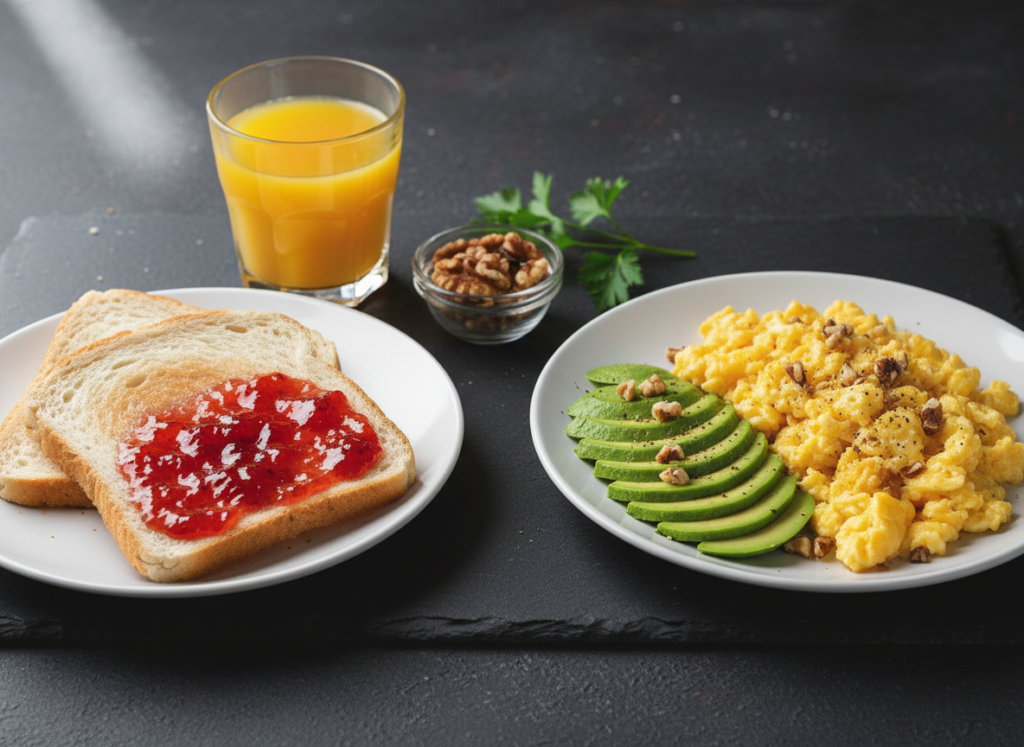
Orange juice was the biggest one for me. A single glass — even fresh — can contain 25 grams of sugar with almost no fiber. The fiber in whole fruit slows glucose absorption. Juicing removes that entirely. I stopped drinking juice and noticed a difference within the first week. That alone was enough to convince me to keep going.
Instant oatmeal was next. Regular rolled oats are not terrible, but the packets — processed, flavored, sweetened — spike blood sugar almost as fast as candy. I tested this on myself and the results were hard to argue with. The kind that takes 30 seconds to make is not the same food as oats that take 20 minutes.
Whole wheat toast is more complicated. It is better than white bread. But not by nearly as much as the packaging implies. Bread in general — even the good kind — digests quickly. Two slices with jam in the morning, on low insulin sensitivity, is a significant blood sugar event. I did not want to believe this. But it kept showing up in how I felt.
Flavored yogurt surprised me the most. Yogurt feels virtuous. But low-fat flavored yogurt often contains as much sugar as a dessert — because when manufacturers remove fat, they add sugar to compensate for the lost flavor. I switched to plain full-fat Greek yogurt and the difference was significant. Same food category, completely different impact.
And granola. I loved granola. It felt like the responsible adult breakfast. Most commercial granola is sweetened oats and nuts held together with honey or syrup. The portion sizes on the label are laughably small. Nobody actually eats 30 grams of granola.
What Actually Works — and Why
The shift I had to make was from carbohydrate-first breakfasts to protein-and-fat-first breakfasts. This sounds simple. It genuinely changed how I felt every morning.
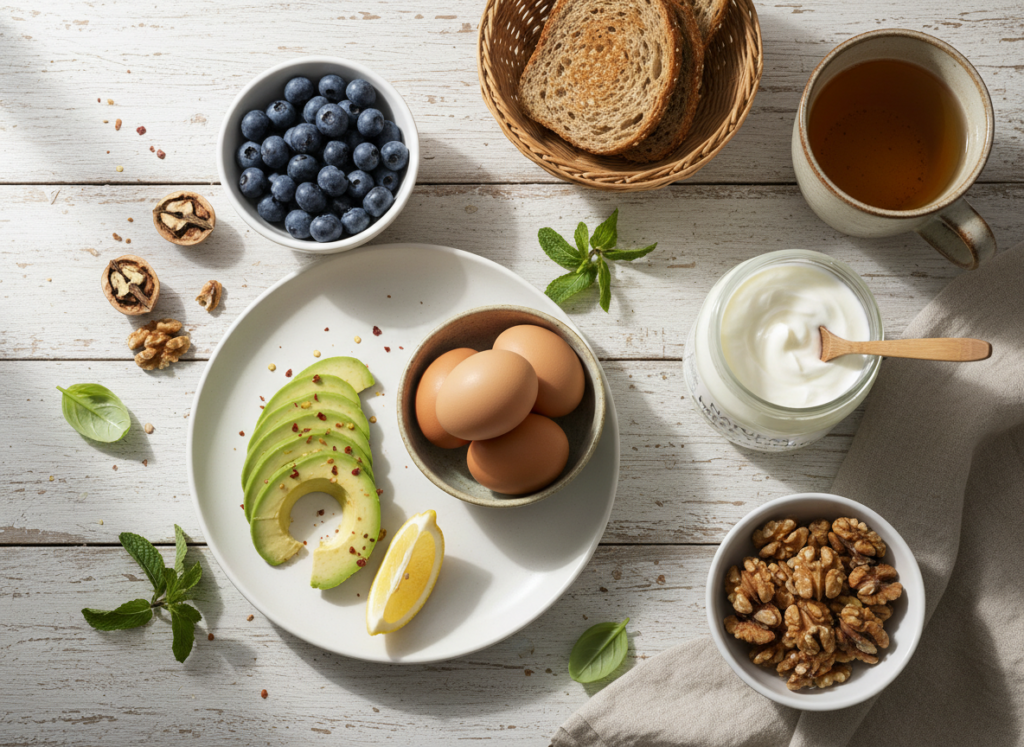
Eggs became the foundation. Two or three eggs, cooked however I felt like — scrambled, fried in olive oil, boiled if I was in a rush. Eggs have almost no impact on blood sugar. They are high in protein, which slows digestion and keeps hunger away for hours. I eat eggs most mornings and I do not get hungry again until well past noon. That alone eliminated most of my mid-morning cravings.
Avocado alongside eggs was something I added after a few months. The healthy fats slow down the absorption of anything else you eat with them. Half an avocado with eggs became a standard morning. It sounds like a lot of food. It does not feel heavy. And it keeps me stable in a way that toast never did.
Plain full-fat Greek yogurt — not the flavored kind — has minimal sugar, real protein, and probiotics. I add a small amount of walnuts and sometimes a few berries. The fat and fiber slow everything down. This is a breakfast that holds for hours. I was surprised by how different it felt compared to the flavored version I used to eat.
Berries are the fruit exception worth knowing about. Blueberries, raspberries, strawberries — lower in sugar than most fruit, high in fiber and antioxidants. A small amount will not spike blood sugar the way a banana or apple will. I use them as an addition to something else, not as the main component. That distinction matters.
The Order You Eat In Changes the Outcome
One thing I did not expect to matter: the sequence of eating. If I do have some carbohydrates at breakfast — a small amount of fruit, occasionally some oats — eating protein and fat first and carbohydrates last significantly reduces the blood sugar spike. There are studies on this. And I noticed it personally before I ever read about it.
Eat the eggs first. Then the avocado. Then whatever carbohydrate you are having, if any. This is not complicated to implement. It just requires changing the order of what you reach for first. The difference in how I felt by 11am was noticeable within a week of doing this consistently.
Delaying breakfast also helped me on the days I tried it. Not eating for the first hour or two after waking — letting cortisol settle — meant my blood sugar was lower when I finally ate. I do not do this every day. But on mornings when I am not hungry right away, I stopped forcing myself to eat immediately. That was a surprisingly easy change that made a real difference.
Changing breakfast was the highest-impact single change I made for blood sugar. More than cutting sugar at dinner. More than adding exercise.
Learn More About Sugar Defender 24 →
The Supplement That Filled the Remaining Gap
I want to be honest about this part. I am not someone who reaches for supplements first. I tried to manage everything through food and lifestyle, and that handles most of it. But after several months of doing everything right and still seeing more variability than I wanted in my morning numbers, I started looking at what the research actually supported.
The ingredients that kept appearing in the research — berberine, chromium, cinnamon extract — were the ones I focused on. Not marketing language. Actual studies. Something that genuinely helped me alongside all of this was Sugar Defender 24 — I was skeptical at first, but after a few weeks I noticed my afternoon energy was more consistent and the mid-morning crashes I used to get almost every day became much less frequent.
It is not a replacement for eating differently in the morning. Nothing replaces that. But alongside the food changes, it addressed something I had not been able to close on my own.
Making the Change Without Overhauling Everything at Once
The biggest challenge with breakfast is that it is the most habitual meal. You wake up and reach for what you always reach for. Changing that requires friction, and friction is annoying at 7am.
What actually helped me was preparation. I hard-boil a batch of eggs on Sunday. On busy mornings, I grab two, cut an avocado, and breakfast is done in four minutes. No decisions. No reaching for the easiest thing because I am half awake. Having the right food already ready removes the moment where the wrong choice happens.
I also stopped buying the things I was trying to avoid. If flavored yogurt is in the fridge on a tired morning, I will eat it. If it is not there, I will eat something else. Your kitchen environment is your first line of defense. This is not a willpower issue. It is an environment issue.
If you cannot eliminate carbohydrates at breakfast entirely — and I understand that, because I could not either at first — focus on pairing. Never eat carbohydrates alone in the morning. Always have protein and fat alongside them. Toast with eggs is significantly better than toast alone. The pairing changes the rate of absorption and reduces the spike. Start there if going fully low-carb at breakfast feels like too much.
Coffee matters too. Black coffee slightly raises cortisol and can nudge blood sugar up a little on its own. Adding full-fat cream does not meaningfully worsen this. Adding sugar or flavored syrup does. I drink my coffee with a small amount of cream now. Sweetened café drinks are a different category entirely — those I avoid in the morning completely. As for the connection between sleep and blood sugar, poor sleep raises cortisol and makes everything harder — including breakfast choices.
What Honest Progress Actually Looks Like
Changing breakfast did not fix everything. Blood sugar is complicated and there are days when I do everything right and my numbers still do not cooperate. Stress, sleep quality, hormones — all of it plays a role that food alone cannot fully override. I want to be clear about that.
But breakfast was the single highest-impact change I made. More than cutting sugar at dinner. More than adding exercise. The morning meal sets a metabolic tone that carries through a significant part of the day. Getting it right — or less wrong — compounds over time in a way that is hard to fully explain until you have experienced it.
The changes were gradual. I did not go from cereal to eggs overnight. I removed one thing, paid attention, removed another. Added something new, kept it or dropped it based on how I actually felt. That process is slower than following a strict list of rules. But it is the process that sticks. And understanding how to lower blood sugar naturally across the whole day made breakfast changes feel like part of a larger picture rather than an isolated sacrifice.
If you take nothing else from this: protein and fat first, carbohydrates last if you have them at all, and stop drinking juice. Those three changes alone will change how you feel before 10am. Everything else is refinement from there.
Also Recommended: Support Your Health Naturally
Many people looking to manage blood sugar also love the Medicinal Garden Kit — a collection of powerful healing plants you can grow at home for natural wellness support.